One-Page vs. Multi-Page Website: Which Is Right for Your Business?
By Joe Fredrick • August 15, 2026

10 Minute Read
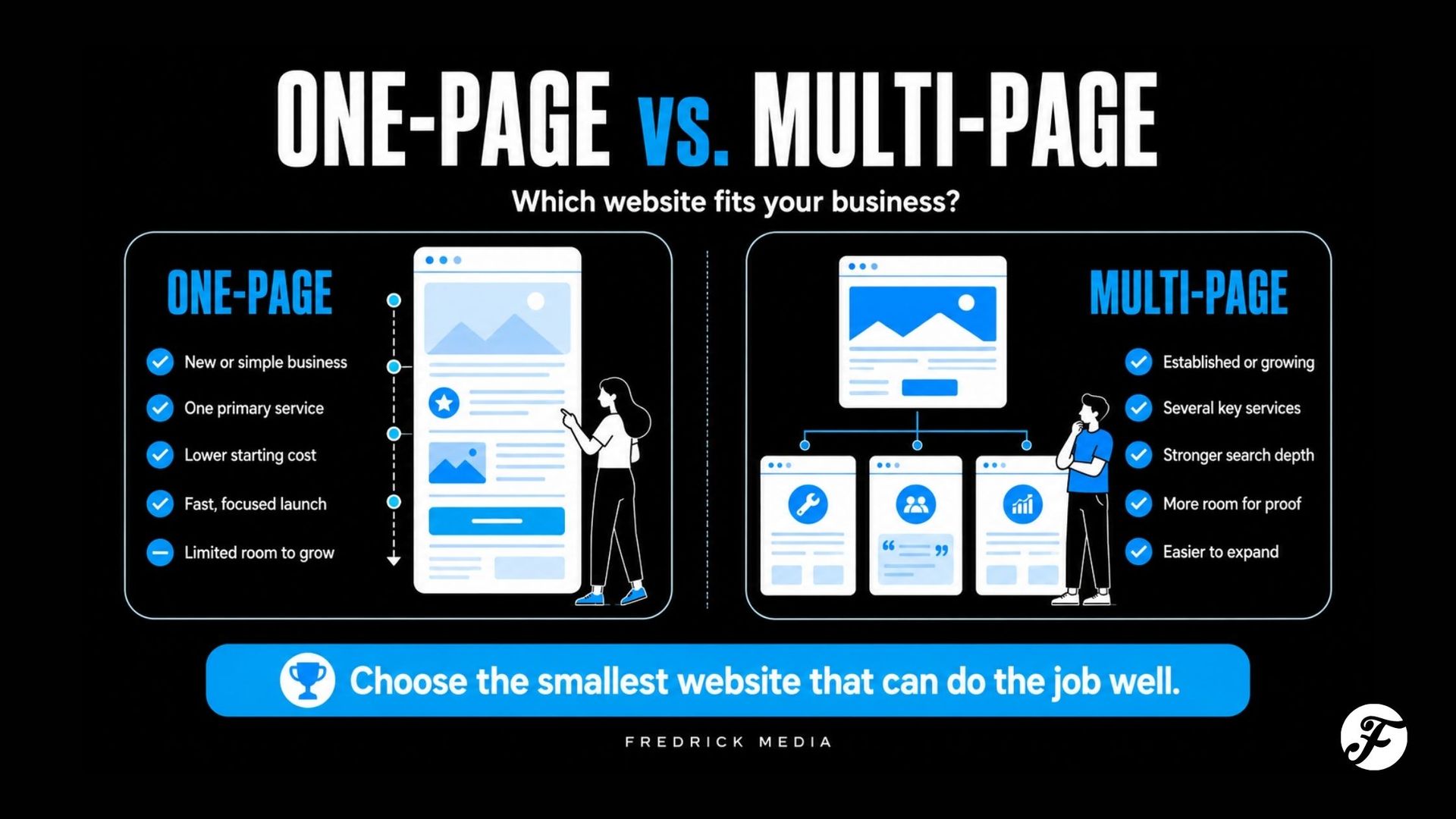
A one-page website is often enough for a new or smaller business with one main service, one audience, and a simple service area. A multi-page website is usually the better choice for an established business with several important services, more information customers need before calling, or goals for stronger search visibility.
You do not earn extra credit for having more pages. You need enough room to answer the questions that help the right customer understand, trust, and contact your business.
For many local service businesses, the practical starting points are:
- One page: A focused introduction with the essentials
- Five pages: A complete small business website with room for services and trust
- Ten or more pages: A deeper site for multiple services, locations, projects, or ongoing SEO
The right choice is the smallest website that can do its job clearly without cramming important information together.
Quick One-Page vs. Multi-Page Website Comparison
| Factor | One-page website | Multi-page website |
|---|---|---|
| Best fit | New or simple businesses | Established or growing businesses |
| Services | One main service category or a short related list | Several services that need explanation |
| Typical navigation | Links scroll to sections on one page | Links open separate pages |
| Upfront cost | Usually lower | Usually higher |
| Content depth | Focused and brief | More room for detail and proof |
| Search potential | Limited number of distinct search topics | Each useful page can target a distinct intent |
| Maintenance | Fewer sections to manage | More pages to keep accurate |
| Growth | Can become crowded as content expands | Easier to add services, projects, and locations |
If the decision is still unclear, ask one question:
→ Can one page fully explain what we do, where we work, why customers trust us, and how to get started—without feeling rushed or overloaded?
If yes, start with one page. If not, give the information room to breathe.
RELATED: How Much Does a Small Business Website Cost in Wisconsin?
What Is a One-Page Small Business Website?
A one-page website places the main business information on a single long page. The navigation usually jumps visitors to sections such as Services, About, Reviews, and Contact rather than opening separate URLs.
A useful one-page site might include:
- A clear opening statement
- A short overview of services
- The cities or region served
- Reasons to trust the business
- A simple explanation of the process
- Reviews or examples of completed work
- Frequently asked questions
- A phone number, form, or other next step
That is still a real website—not a digital business card—when each section is planned well.
When a one-page website works well
A one-page site can be a smart fit when:
- The business is new and needs a credible starting point
- One primary service drives most of the work
- All services speak to the same type of customer
- The service area is straightforward
- Customers make a relatively simple decision
- The owner has a focused budget
- The alternative is relying only on Facebook or an incomplete listing
Imagine a new lawn-care business offering mowing and basic seasonal cleanup within a small part of the Fox Valley. One strong page can explain the service, show real work, name the service area, answer common questions, and make requesting an estimate easy.
The business does not need five nearly empty pages just to appear established.
Advantages of a one-page website
Lower starting cost. There is less strategy, writing, design, and development than a larger site normally requires.
A simpler message. When the offer is focused, visitors can move from the main promise to proof and contact without choosing among many pages.
Faster content gathering. A new owner may only need a concise company story, a service description, a few good photos, and clear contact information.
A practical first step. The business can establish an owned online presence while leaving room for a larger website later.
Limitations of a one-page website
One page has to carry every important job. As the business grows, it can become long, crowded, and difficult to organize.
It also has limited room to serve different search intents. A single page might mention roofing, siding, gutters, and garages, but it is difficult for that one URL to be the clearest answer for every service.
A one-page site may become too small when:
- Important services need their own explanations
- Customers have very different questions by service
- The business wants to rank for several competitive services
- Multiple service areas require useful local evidence
- Project galleries or case studies matter to the sale
- The company serves residential and commercial audiences differently
- Visitors struggle to find a specific detail on the long page
One page should be chosen because it fits the business—not merely because it is the cheapest option.
What Is a Multi-Page Business Website?
A multi-page website separates information into individual URLs. A typical five-page business website might include:
- Home — A clear overview of the business, services, proof, and next step
- Services — A useful explanation of what the company offers
- About — The people, experience, values, and story behind the business
- Projects or Reviews — Evidence that helps customers feel confident
- Contact — Service-area details, expectations, and an easy inquiry path
The exact five pages should follow the buying decision. A plumber may benefit more from a dedicated Emergency Plumbing page than a gallery. A custom builder may need Projects more than a general Services page. A surveyor may need distinct service explanations because an ALTA survey and a residential boundary survey solve different problems.
When a multi-page website works well
A multi-page structure is usually better when:
- The business offers multiple profitable services
- Each service needs meaningful explanation
- Customers compare the company carefully before contacting it
- Search visibility is an important growth goal
- The company has substantial experience, reviews, projects, or credentials
- Different audiences need different information
- The site will grow over the next few years
Advantages of a multi-page website
More clarity. Each page can answer one group of related questions without forcing visitors through unrelated content.
Greater search depth. A roofing page can focus on roof replacement, while a siding page can focus on siding. Search engines and customers receive a clearer answer than a short paragraph about each service on one general page.
Better internal paths. A visitor can move from a service page to a relevant project, FAQ, review, or contact option.
Room to build trust. The site can show team members, process, credentials, projects, testimonials, warranties, and detailed expectations without overcrowding the homepage.
Easier expansion. New service pages, location resources, articles, and case studies can be added within an organized structure.
Limitations of a multi-page website
More pages require more planning, writing, images, design, testing, and maintenance. Empty pages do not help anyone. Neither do five pages that repeat the same vague claims.
A larger website can also create confusion when:
- Navigation contains too many choices
- Several pages compete for the same topic
- Service pages contain only a few generic sentences
- Old services and staff information are never updated
- Location pages repeat identical copy with city names swapped
A multi-page website should create depth, not clutter.
Does a Multi-Page Website Rank Better on Google?
Not automatically.
Google does not reward a business simply for reaching a certain page count. A useful, focused one-page site can outperform a thin five-page site. A well-planned multi-page site, however, has more opportunities to answer distinct searches with genuinely relevant pages.
For example, one general contractor page may struggle to cover all of these searches well:
- Roof replacement in Appleton
- Vinyl siding contractor
- Custom garage builder
- Storm-damage roofing help
Separate pages make sense when the business has enough real knowledge, proof, and customer information to create a strong resource for each topic.
More pages become valuable when each one has a clear purpose. Publishing dozens of weak pages to collect keywords is not a sound strategy.
When Should Services Get Separate Pages?
Give a service its own page when several of these statements are true:
A roofer offering roof replacement, roof repair, siding, and custom garages probably has enough distinct information for separate pages. A lawn service listing mowing, edging, and blowing as parts of one weekly visit probably does not need three separate pages.
Group closely related tasks when separating them would feel artificial. Separate services when doing so makes the decision easier for the customer.
Simple Website Structure Decision Chart
| Your situation | Recommended starting point | Why |
|---|---|---|
| New business, one main service, limited content | One-page website | Establishes a professional presence without unnecessary pages |
| Solo operator with a small related service list | One page or focused five-page site | Depends on how much each service needs explained |
| Established business with several services | Five-page or larger website | Creates room for trust, details, and clearer navigation |
| Contractor with several high-value service categories | Ten or more pages | Individual service pages can support buyers and search visibility |
| Business serving residential and commercial customers differently | Multi-page website | Each audience can follow a more relevant path |
| Company targeting several important cities | Expanded website | Useful location content and local proof need room |
| Business investing in ongoing SEO or content | Expanded website | A scalable structure prevents future content from becoming disorganized |
| Business that needs only a credible temporary presence | One-page website | Provides a clean starting point that can be rebuilt or expanded later |
Five Questions to Ask Before Choosing
1. How many services truly matter?
List the services you actively want to sell—not every task you have ever completed.
If there is one primary category, one page may work. If several services produce meaningful revenue and require different explanations, plan for more pages.
2. What do customers need to know before calling?
Consider price factors, process, timing, service area, warranties, licensing, project minimums, and proof. The more considered the purchase, the more room the website may need.
3. How important is search visibility?
A one-page site can appear in search, especially for a branded or focused local query. A business pursuing several services and markets usually needs a deeper content structure.
4. What credible content do you have?
Real photos, projects, reviews, credentials, and specific answers justify additional pages. Do not buy a large page count if there is nothing useful to put on those pages yet.
5. Where will the business be in two years?
If you expect to add crews, markets, or services soon, starting with a scalable structure may prevent an early rebuild. If the business model is intentionally simple, a larger site may never be necessary.
Common Mistakes to Avoid
Choosing by page count alone
Five pages from one provider may include thoughtful strategy and copy. Ten pages from another may be lightly edited templates. Compare what the pages accomplish, not only how many appear in the quote.
Cramming everything onto one page to save money
A one-page website stops being affordable if customers cannot understand it or if it must be replaced immediately after the business adds a second important service.
Adding thin pages to look bigger
A separate page with two sentences and a stock photo rarely improves trust. Combine thin topics until there is enough useful information to justify separation.
Treating every city as a separate copy-and-paste page
Location pages need a real reason to exist. Useful pages may include service differences, projects, customer questions, photos, or other local evidence. Replacing “Neenah” with “Appleton” throughout the same copy does not create genuine value.
Forgetting mobile visitors
A long one-page website can feel especially long on a phone. A multi-page website can create too many menu choices. Either structure should be tested on a small screen with obvious calls to action.
Wisconsin Example: One Business at Two Stages
Imagine a new concrete-curbing company serving Neenah, Menasha, and Appleton.
At launch, one page may be enough to explain decorative curbing, show several installations, describe the basic process, answer common questions, and collect estimate requests.
Two years later, the company offers landscape borders, commercial curbing, resealing, and repairs. It has dozens of projects, serves a wider area, and wants steady organic search growth.
The original page did not fail. The business outgrew it. A multi-page website now gives each important service and proof category the space it has earned.
The best website structure can change as the company changes.
FAQs
Is a one-page website professional enough for a small business?
Yes. A well-planned one-page website can look professional, build trust, and generate inquiries. It is best suited to a focused business with one main service category and a simple customer decision.
Is a one-page website bad for SEO?
Not inherently. One useful page can rank for focused searches, but it has limited ability to cover several distinct services and search intents. A growing business often benefits from separate, substantial pages.
How many pages should a small service business website have?
Many established service businesses need at least five core pages. Companies with several important services, markets, or SEO goals may need ten or more. A new, focused business may only need one strong page.
RELATED: How Many Pages Does a Small Service Business Website Really Need?
Can a one-page website become a multi-page website later?
Usually, yes. Plan the original content carefully so important sections can later become separate pages. Ask the web provider whether expansion will require a rebuild or can happen within the existing platform and design.
What pages should a five-page business website include?
A common structure is Home, Services, About, Projects or Reviews, and Contact. The exact pages should reflect the customer’s questions. A valuable service page may be more useful than a general gallery or About page for some businesses.
Do more website pages mean more leads?
No. More useful pages can support more customer questions and search intents, but page count alone does not create demand or conversions. Clear messaging, proof, usability, visibility, and a strong next step matter more.
Choose the Smallest Website That Can Do the Job Well
Fredrick Media offers a one-page Starter Website for focused businesses, a five-page Professional Website for established service companies, and custom Expanded Websites for businesses that need individual service pages, location content, or a deeper search strategy.
I’ll help you decide what the business actually needs, write the copy, organize the pages, and keep the project moving. You will not be pushed into extra pages simply to make the proposal larger.

About the Author
Joe Fredrick is the owner of Fredrick Media, a web design and local marketing company based in Neenah, Wisconsin. Since 2018, he has helped Wisconsin service businesses build stronger websites, improve their local visibility, and turn more online searches into real opportunities.
Is Your Website Pulling Its Weight?
Get a free website review with practical ideas to win more business.
Monthly Tips to Win More Local Work
Straightforward small business marketing advice sent to your inbox.
Contact Us
We will get back to you as soon as possible.
Please try again later.
SHARE THIS
Latest Resources