How Much Does a Small Business Website Cost in Wisconsin?
By Joe Fredrick • July 22, 2026

11 Minute Read
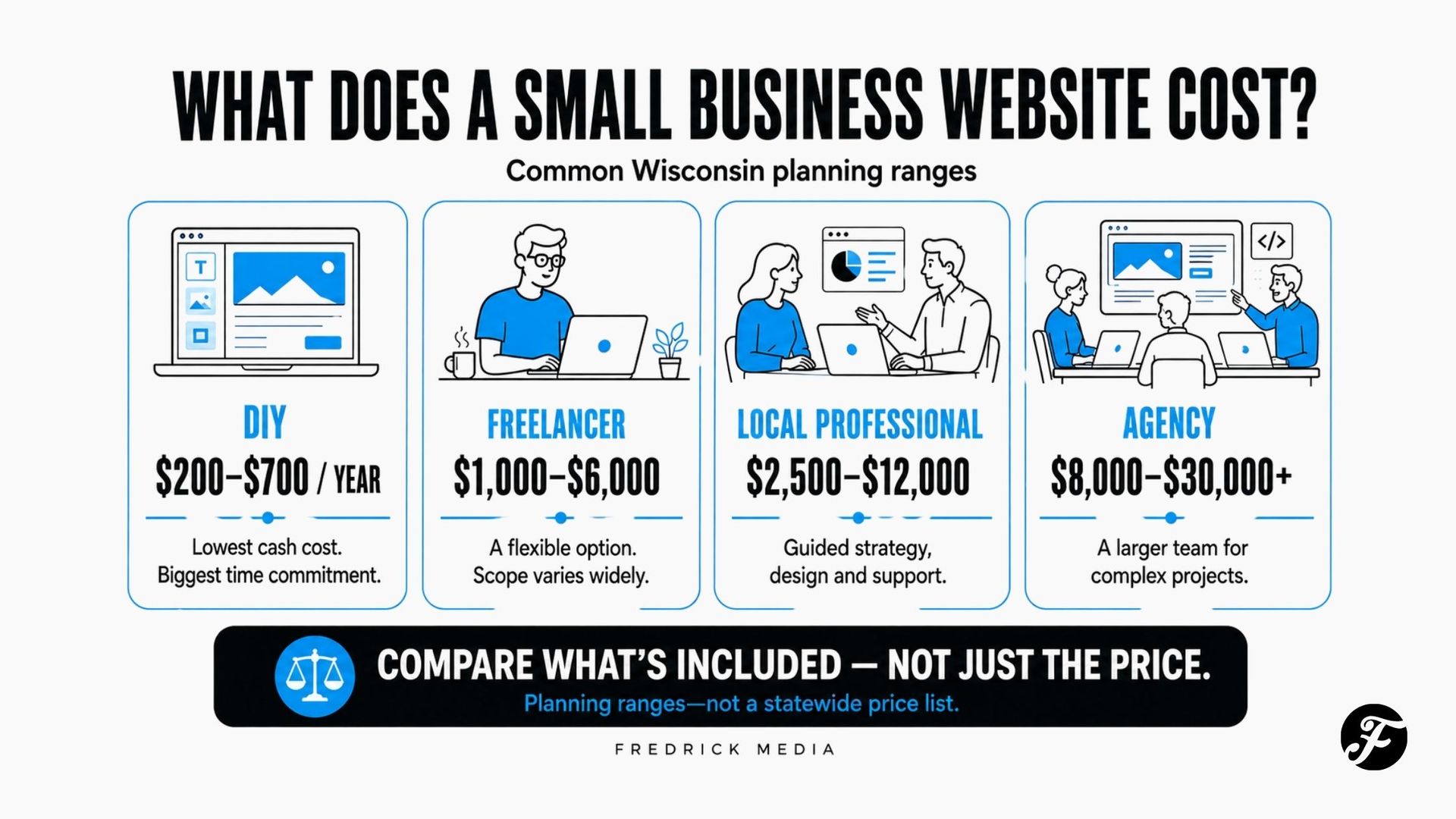
A small business website in Wisconsin can cost a few hundred dollars per year for a do-it-yourself website, roughly $1,000–$6,000 from a freelancer, $2,500–$12,000 from an established local professional, or $8,000–$30,000 or more from an agency.
Those are planning ranges—not a statewide price list. A focused five-page contractor website and a custom online store are completely different projects, even if both are called “small business websites.” Experience, scope, copywriting, design, functionality, and support can also move a project well outside the ranges above.
The useful question is not simply, “What does a website cost?” It is:
→ What should this website accomplish, what work is included, and who will be responsible for getting it done?
A $500 website can be expensive if it wastes your time and never earns trust. A $5,000 website can be a sensible investment if it clearly explains your services and helps win profitable work for several years.
Quick Website Cost Comparison
| Website approach | Common planning range | Usually includes | Best fit |
|---|---|---|---|
| DIY website builder | About $200–$700 per year, plus your time | Platform, hosting, templates, basic tools | New businesses with more time than budget |
| Freelancer | About $1,000–$6,000 | Varies widely; often design and setup | Small projects with a clear scope |
| Local web professional | About $2,500–$12,000 | Often strategy, design, development, and support; verify copy and SEO | Established local service businesses |
| Full-service agency | About $8,000–$30,000+ | Multi-person strategy, design, development, and project management | Larger companies or complex projects |
| E-commerce or custom functionality | Often $10,000–$50,000+ | Store setup, product systems, payments, integrations, or custom development | Businesses with operational or selling requirements |
These ranges overlap because the label does not tell you everything. One freelancer may be an experienced specialist who handles strategy, copy, design, and launch. Another may install a template and ask you to supply everything. One agency may build straightforward marketing sites; another may focus on complex custom development.
Compare the scope, not just the title on the proposal.
Option 1: Build It Yourself
A do-it-yourself website is usually the lowest cash-cost option. Website builders commonly charge monthly or annual platform fees, and you may also pay for a domain, business email, premium templates, scheduling tools, forms, or other apps.
A reasonable DIY budget
Plan on approximately $200–$700 per year for a basic small business website. The total can be higher if you need e-commerce, booking, premium applications, or outside help.
The bigger expense is your time. You are responsible for:
- Choosing the page structure
- Writing and editing the copy
- Selecting and preparing photos
- Building desktop and mobile layouts
- Connecting the domain
- Setting page titles and descriptions
- Testing forms and links
- Learning the platform
- Maintaining the website after launch
DIY can be a smart choice when the business is new, the offer is simple, and money is tight. A clean, accurate one-page site you finish is more helpful than a larger professional project that remains unaffordable and never begins.
It becomes less affordable when the owner loses several workdays fighting the builder, settles for unclear messaging, or leaves the site half-finished for months.
Best for
- Brand-new businesses validating an idea
- Simple services with limited content
- Owners who enjoy technology and writing
- Businesses that need a temporary starting point
- Situations where cash must be conserved
Watch for
- Introductory prices that rise at renewal
- Paid apps required for basic features
- Templates that look good but do not fit your content
- Weak mobile layouts
- A platform you cannot easily move away from
- Time that should have been spent serving or selling to customers
Option 2: Hire a Freelancer
Freelancer pricing varies more than almost any other category. You may find a beginner building a first portfolio, an overseas developer completing a narrow task, or a highly experienced local specialist running a one-person business.
A reasonable freelancer budget
A straightforward small business website may cost approximately $1,000–$6,000. Experienced specialists, larger sites, and custom development can cost more.
Before comparing freelancer proposals, find out whether the price includes:
- Website planning and page recommendations
- Copywriting or only placement of your copy
- Custom design or a lightly edited template
- Mobile optimization
- Basic search optimization
- Image selection and preparation
- Forms and integrations
- Domain and launch work
- Revisions
- Training or support after launch
A $1,500 proposal that requires you to write every word, locate every image, define the structure, and handle launch is not directly comparable to a $4,000 proposal that includes those responsibilities.
Best for
- Clearly defined brochure-style websites
- Owners who want direct communication
- Businesses that already have strong copy and photos
- Projects suited to one person’s skill set
- Businesses that want a middle ground between DIY and an agency
Watch for
- A skill gap outside the freelancer’s specialty
- Limited availability if that person becomes busy or unavailable
- Unclear revision limits
- No documented process for domain ownership or handoff
- A low quote built around work you assumed was included
Option 3: Work With a Local Web Professional
A local web professional may also be a freelancer in the legal sense, but the service is usually positioned as a guided business project rather than a set of production tasks.
The person may help decide what pages you need, interview you about the business, write or shape the messaging, organize services, design the site, prepare it for local search, and support it after launch.
A reasonable local-professional budget
For a typical Wisconsin service-business website, approximately $2,500–$12,000 is a useful planning range. A focused one-page site may fall below it. A larger search-focused site, extensive copywriting project, or custom build can exceed it.
This option often fits a contractor or service-business owner who does not want another project to manage. You still need to provide business knowledge, approvals, and real photos when possible, but the web professional should guide the process.
Best for
- Established local service businesses
- Owners who want to work directly with the person doing the work
- Businesses that need help with copy and structure
- Website redesigns that must preserve important content or search equity
- Companies that value ongoing access to a known local partner
Watch for
- “Local” providers who quietly outsource everything without explaining it
- A polished sales process followed by poor communication
- Vague promises about SEO
- Required monthly charges that were not clear in the proposal
- No plan for updates after launch
Option 4: Hire an Agency
An agency typically brings several roles to the project: strategy, account management, copywriting, design, development, SEO, and sometimes photography, branding, advertising, or analytics.
A reasonable agency budget
Many small business agency projects begin around $8,000–$30,000 or more. Specialized branding, e-commerce, advanced integrations, custom software, or a large amount of content can push the total much higher.
The higher cost may be worthwhile when a company has complex needs, several decision-makers, an aggressive timeline, or a brand and website project that requires a broader team.
It may be unnecessary for a local owner who needs five clear pages, straightforward lead generation, and one reliable person to call.
Best for
- Larger organizations with multiple stakeholders
- Complex websites and integrations
- Projects combining branding, content, development, and campaigns
- Companies that need capacity across several specialties
- Businesses with formal procurement or compliance needs
Watch for
- Paying for layers of management your project does not need
- Working mainly with an account manager instead of the people doing the work
- Long timelines for a relatively simple site
- Ongoing retainers bundled into the project
- A process designed for bigger organizations than yours
What Affects Contractor Website Cost?
Two Wisconsin contractors can request “a new website” and receive very different quotes because the underlying work is different.
1. Number and depth of pages
A focused one-page site costs less than a site with separate pages for roofing, siding, windows, gutters, service areas, projects, financing, and frequently asked questions.
Page count is not the only issue. A detailed service page with research, interviews, original copy, projects, and custom layouts requires more work than a short contact page.
2. Copywriting
Some web design prices assume you will deliver polished, final copy. Others include interviews, research, positioning, writing, editing, and page organization.
For many busy owners, included copywriting is one of the most valuable parts of a professional project. It prevents the website from stalling because a blank document has been sitting in the owner’s inbox for three months.
Ask exactly who writes the copy and how many rounds of revisions are included.
3. Template-based or custom design
A good template can provide an efficient foundation. Custom design gives the website more flexibility to reflect the company’s content, personality, services, and customer journey.
“Custom” is used loosely in web proposals. Ask whether the provider is designing around your business or mainly replacing text and colors in a prebuilt layout.
Neither method is automatically right or wrong. The price should match the work being performed.
4. Features and integrations
These additions can increase the cost:
- Online scheduling
- Estimate calculators
- Customer portals
- Membership areas
- E-commerce
- Payment processing
- Advanced forms
- CRM connections
- Inventory systems
- Job-board or real-estate feeds
- Multilingual content
- Custom databases or software
A standard contact form is routine. A form that calculates prices, routes leads, takes deposits, and syncs with several systems is a development project.
5. Search strategy
Basic local SEO foundations may include page structure, headings, titles, descriptions, mobile usability, and clear service-area language.
Keyword research, competitive analysis, location strategy, content expansion, link building, ongoing optimization, and reporting are usually separate or significantly increase the scope.
Be cautious when a low-priced website promises to “include SEO” without explaining what that means.
6. Photography, video, and branding
Real project and team photos can make a service business more believable. Professional photography, video, logo design, illustration, or a complete brand identity may be quoted separately.
If you already have an established logo and an organized collection of strong photos, the website project may require less creative production.
7. Content migration and redirects
Replacing an existing website can involve more than building new pages. Someone should review useful old URLs, preserve valuable content, move blog posts when appropriate, redirect retired pages, transfer forms, and check tracking tools.
Skipping this work can create broken links and unnecessary losses in search visibility.
8. Project management and support
A guided process costs more than access to a page builder. Clear communication, scheduled reviews, content organization, testing, launch help, training, and post-launch support are real parts of the work.
For a busy owner, paying someone to keep the project moving can be more valuable than paying only for the final pixels.
Recurring Website Expenses to Plan For
The initial build is not the only website expense. Ask for a written list of required and optional recurring costs before signing.
| Recurring item | Common planning amount | What to ask |
|---|---|---|
| Domain name | About $15–$40 per year | Who owns it, who renews it, and where is it registered? |
| Hosting or website platform | About $200–$1,000+ per year | Is it included in a care plan? What happens if you leave? |
| Maintenance and support | About $500–$3,000+ per year | What updates, checks, and response times are included? |
| Premium apps or licenses | $0–$1,000+ per year | Which features stop working if a license is canceled? |
| Business email | Often priced per user per month | Is email separate from the website and who manages it? |
| Ongoing SEO or marketing | Separate monthly service | What work and reporting are included? Is it optional? |
These are broad planning numbers. Platforms and service models vary widely.
Also separate website care from ongoing marketing. Hosting, security, platform maintenance, and small updates keep the website working. SEO, content, ads, listings, and conversion work are intended to improve visibility or results. They are not the same service.
How Fredrick Media Prices Small Business Websites
Fredrick Media publishes its starting prices so Wisconsin owners can decide whether a conversation makes sense before reaching out:
| Package | Starting price | Designed for |
|---|---|---|
| Starter Website | $1,000 | A new or smaller business needing one focused page |
| Local Authority Website | $2,500 | An established service business needing five complete pages |
| Expanded Website | $5,000+ | A growing business needing 10+ pages, deeper services, locations, or search content |
| Website Care | $599 per year | Hosting, support, basic maintenance, checks, and reasonable small copy or image updates |
Website strategy, professional copywriting, custom design, mobile-friendly development, local SEO foundations, clear calls to action, launch, and ongoing support are included in the website process.
That does not mean every business should choose Fredrick Media—or the same package. A brand-new owner who enjoys building things may be better served by DIY. A company needing a custom customer portal may need a development agency. The goal is to choose the right level of help without paying for unnecessary complexity.
Seven Warning Signs in a Website Quote
1. The scope is described only as “a website”
The proposal should identify pages, responsibilities, features, revisions, timing, and launch work. If the scope is vague, the final bill or final website may be a surprise.
2. No one can explain who owns the domain and accounts
Your business should have clear ownership or appropriate administrative control of its domain, website, Google accounts, analytics, and other essential assets. Do not wait until a relationship ends to ask.
3. The price is low because you are expected to do most of the work
There is nothing wrong with a production-only service if that is what you need. The warning sign is discovering after payment that you must plan every page, write every word, and solve every technical question yourself.
4. Recurring costs are hidden or hard to cancel
Ask about hosting, maintenance, licenses, required marketing, contract length, cancellation, and what happens to the website if you stop paying.
5. The provider guarantees a top Google ranking
No web designer controls Google, competitors, or customer location. A provider can build a stronger foundation and perform useful SEO work, but guaranteed organic rankings are not a responsible promise.
6. There is no plan for phones, forms, or testing
The website should be checked on common screen sizes. Forms, buttons, phone links, redirects, analytics, and core settings should be tested before and after launch.
7. You cannot see relevant work or talk through the process
A portfolio does not need to contain your exact industry, but it should show sound judgment and completed work. The provider should also be able to explain the project in plain language.
What Does “Affordable Small Business Web Design” Really Mean?
Affordable does not always mean cheapest. It means the cost makes sense for the business, the website’s job, and the help included.
A practical website investment should account for:
- The value of one typical customer or project
- How often prospects check the website before calling
- Whether the current site is costing trust
- How much of your own time the process will require
- How long the website is likely to serve the business
- Whether the site can grow without being immediately rebuilt
Suppose a remodeler earns several thousand dollars in gross profit from one appropriate project. A website that helps one or two more good prospects feel confident may justify a professional budget. A new solo business still finding its first customers may need a leaner starting point.
Do not spend money merely to have a nicer website. Spend enough to solve the actual business problem.
Questions to Ask Before Comparing Web Design Prices
Give each provider the same basic information, then ask:
- How many pages and page types are included?
- Who plans the site structure?
- Who writes and edits the copy?
- Is the design custom to my business?
- What local SEO work is included at launch?
- Are mobile layouts built and tested?
- Are forms, analytics, redirects, and domain launch included?
- How many revision rounds do I receive?
- What do I need to provide?
- What will I pay each year after launch?
- Who owns the domain, content, and accounts?
- What support is available when something changes?
With those answers, a $2,500 quote and a $5,000 quote become much easier to compare.
FAQs
How much should a small business website cost in Wisconsin?
For planning purposes, a basic professionally built service-business website often lands between roughly $2,000 and $6,000, although one-page projects may cost less and large, custom, or e-commerce projects can cost far more. The right budget depends on pages, copywriting, design, features, search strategy, and support.
How much does a contractor website cost?
A contractor website may cost around $1,000 for one focused page, $2,500–$6,000 for a clear small site, or $5,000–$15,000+ when it needs individual service pages, location content, project galleries, custom photography, integrations, or deeper SEO work. Ask what is included rather than comparing totals alone.
Can I get a professional website for under $10,000?
Yes. Most service-business websites I build fall under $10,000, with projects ranging from $1,000 for a focused one-page site to $5,000+ for a larger 10+ page website. Fully managed site care and hosting are billed separately at $599 per year, depending on the size of the site.
Why do some web designers charge $500 and others charge $10,000?
They may be selling different work. One may install a template using content you provide. Another may include research, strategy, copywriting, custom design, development, search preparation, project management, testing, and support. Experience and business model also affect price.
Are hosting and maintenance included in web design prices?
Sometimes, but never assume they are. Ask for the first-year cost, future annual cost, required subscriptions, included updates, and what happens if you cancel. Fredrick Media requires Website Care at $599 per year.
Is SEO included with a new website?
Many professional websites include basic SEO foundations, but ongoing SEO is normally a separate service. Ask the provider to define what “SEO included” means. A clear page structure and metadata are different from months of content, optimization, authority building, and reporting.
Choose a Website Budget With Clear Expectations
You should not have to schedule three sales calls just to learn whether a website is remotely within budget.
Fredrick Media offers a one-page Starter Website beginning at $1,000, a five-page Professional Website beginning at $2,500, and custom Expanded Websites for businesses that need more depth. Every project includes help with strategy, copy, design, mobile usability, local search foundations, and launch.
Helpful Pricing References

About the Author
Joe Fredrick is the owner of Fredrick Media, a web design and local marketing company based in Neenah, Wisconsin. Since 2018, he has helped Wisconsin service businesses build stronger websites, improve their local visibility, and turn more online searches into real opportunities.
Is Your Website Pulling Its Weight?
Get a free website review with practical ideas to win more business.
Monthly Tips to Win More Local Work
Straightforward small business marketing advice sent to your inbox.
Contact Us
We will get back to you as soon as possible.
Please try again later.
SHARE THIS
Latest Resources